Just before New Year’s and the turn of the decade, I reached a relatively large personal goal of mine – I read my 200th book. This was a long time coming considering this counts all the books I’ve read in my lifetime. Number 200 was Anne Bogel’s Reading People: How Seeing the World Through the Lens of Personality Changes Everything, a title I found on Kindle Unlimited and didn’t have strong opinions on. It made hitting the big two-zero-zero a little anticlimactic, but I was okay with it not being more impressive. I know not every book on my list is going to be a star.
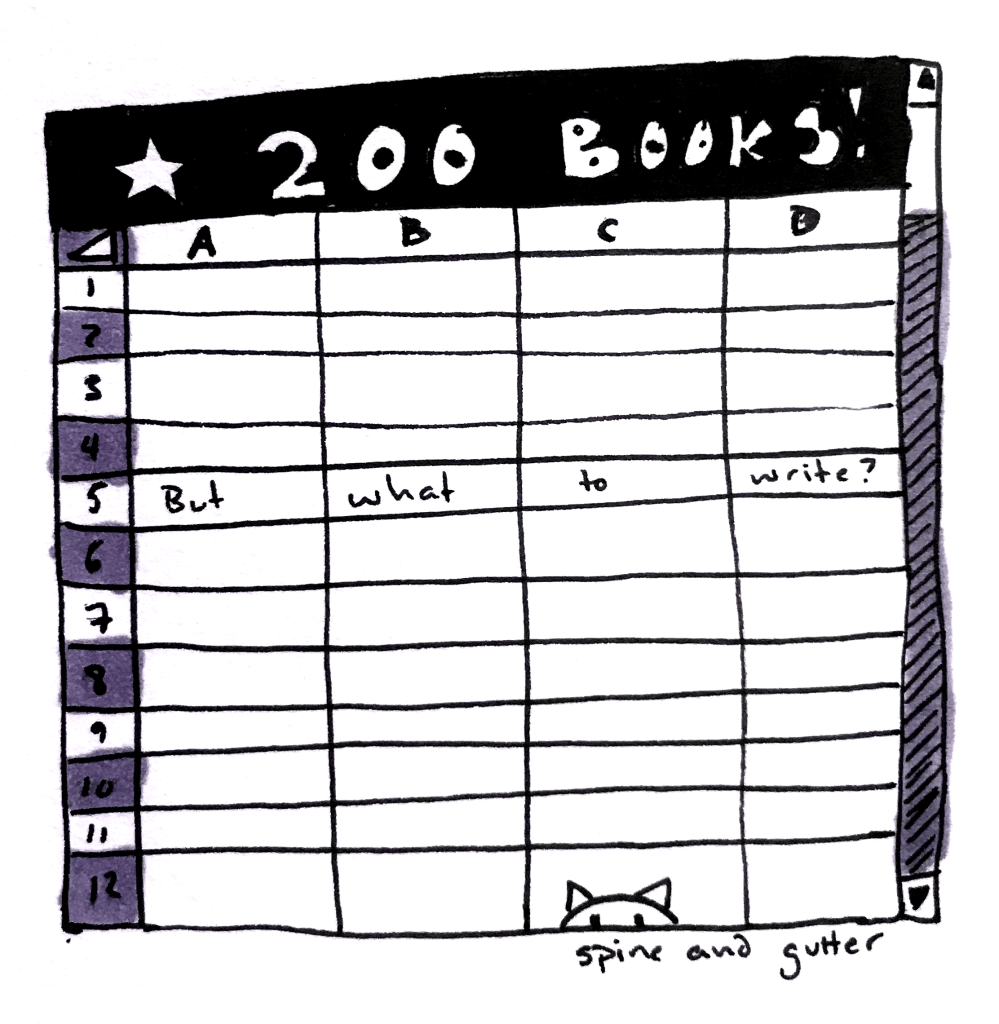
I don’t know if 200 books is a lot, but it felt like a good even number to reach for. I set this goal for myself when I started compiling a list of all the books I’ve ever read and realized I was fairly close at about 185. What you might not expect from such a bookish person such as myself is an intense love for spreadsheets, but something about a well-organized list just hits the spot for me, so about a year ago I started compiling this list as a personal project.
This became an ongoing spreadsheet that tracks the books I’ve read and a lot of information on each book. I track just about everything from the author’s name to the publishing year to my general thoughts on the book. It’s a time consuming effort, but it is incredibly satisfying to see it done.
A disclaimer
I’ve reached 200 titles, but it feels important to mention that I had to make decisions about what to include on my list. If you’re interested in doing this yourself (and I am certainly not the first one to do so), your list may end up looking radically different. For example, I included books of poetry whereas someone else might not. I didn’t include textbooks and other instructional books from school. One or two made the cut (see Maria Tatar’s book on fairytales, for example) though, so my rules aren’t exactly firm. I didn’t include children’s books before around 2nd grade (7-8 years old) just because it would be impossible to reach that far back. I did, however, include books that I didn’t completely finish, justifying that by saying that if I don’t include re-reads in my overall page count, it all balances out somewhere – you might prefer to only count the exact number of pages you’ve read or leave an unfinished book off the list entirely. It’s the beauty of choice.
And while my memory for this sort of thing is surprisingly strong (or so I think), it’s absolutely not perfect, and there are definitely books missing from the list.
So 200 is actually kind of a fuzzy number, but I feel that it’s a pretty accurate reflection of what I’ve accomplished since I became a “big reader” (Again I’m hesitant to say 200 is actually a big number without having anything to compare it to. I know plenty of people my age who seem to eat books for breakfast and plenty of people my age who haven’t cracked a book in years.) Regardless, having this spreadsheet helps me look at the trends and habits in ways that I would not otherwise have been able to.
What exactly have I learned?
The titles
There’s not a whole lot to say about the titles of my books title-wise except to say that, when alphabetized, Charles Dickens’s A Christmas Carol is at the top and M. Nourbese Phillip’s Zong! Is at the bottom (and 1984 is the only numerical title.) It’s funny to me that these books also happen to be about as different as you can get.
Not a single title starts with the letter K, Q, or X. I’d like to fix that so that I have at least one book for every letter of the alphabet, so please, send reading suggestions if you have them.
Series were kept together, but I’ve rarely finished them. The Harry Potter series seems to be the only one I reached the end of.
And for those who are wondering, I elected to keep the’s ahead of their titles (The Giver versus Giver, The.)
The authors
The most popular authors were JK Rowling (7 titles), William Shakespeare (6 titles), Limony Snickett (6 titles), R.L. Stine (6 titles*) Stephanie Meyer (4 titles), Gordon Korman (3 titles), and Lois Lowry (3 titles). Looking at this list, I wouldn’t call any of these authors my “favorite,” and it’s also pretty telling about my general disinterest in long series.
*I’ve definitely read more of R.L. Stine’s books, but I included the ones I knew for sure that I had read. I’ll make a post about the Goosebumps series sometime in the future.
I kept biographical data on the authors which resulted some interesting findings. It’s no surprise to me that most of the books were written by white men (I would say “old” white men, but I didn’t keep track of anyone’s birth year) given just how many of them I read for school. About 170 of the 200 books were written by white authors, and 115 of the 200 were written by men. Most of the authors came from either England/the UK or the United States, with a few guest appearances by Canadians.
The worst realization for me was that a number of books I thought were written by non-white authors were in fact written by white authors (or books I thought were written by non-Americans were actually written by Americans.) Julie of the Wolves is a good example. I read it in about 4th grade so I wasn’t thinking too deeply about authorship at the time, but I was genuinely surprised to rediscover it was written by a lady named Jean Craighead Moore.
In general, I don’t usually pick books by their authors and instead read tend to gloss over authors entirely in favor of content, but I do think there’s a lot to gain from reading a diverse selection. Reading more books from authors of different backgrounds (as well as more books in translation, given I’ve read maybe 25 books not originally written in English) is a goal of mine for this new year.
Page count
Page count is probably my favorite part of this list. I’ve read approximately 57,590 pages, which is a crazy high and seemingly meaningless number. It’s so far from a million, yet it feels like I’ve read a million pages.
57,590 pages over 200 books averages out to about 289 pages per book. I love to watch this average go up and down as I add to the list. I’m trying to push this number higher by reading bigger books, but it’s a surprisingly hard thing to do. Ah, statistics.
The smallest title is Charlotte Perkins Gilman’s The Yellow Wallpaper at 29 pages. This is actually a short story, but I have no desire to take it off my list.
The 25 to 100 page range is mostly poetry, and books I read in elementary school average about 150 pages.
The longest titles are Ezra Pound’s The Cantos and JK Rowling’s Harry Potter and the Order of the Phoenix at 896 pages each (depending on the edition) following by Dan Simmons’s The Terror at 784. Only one of these books I really enjoyed, and I’ll leave you to decide which.
Publication year
This is the next best part of the spreadsheet because once again I can watch the average number bounce up and down.
The earliest title on my list is Sophocles’s Oedipus Rex from around the year 429. The most recent is George Saunders’s Lincoln in the Bardo published in 2018. The average year is 1940, so clearly I don’t read a ton of contemporary work.
I think it might be interesting to go back and make a list of every year from 1800 to 2020 and try to check off a book from each year, but that is a lot of books. I haven’t even read anything from 2019 yet, which really makes me doubt my status as a book worm.
Format
I did my best to keep track of what formats I read these books in to the best of my memory. Physical books (hard cover and soft cover) dominate, but audiobooks and digital formats are on the rise as about 90% of the books I’ve read in the past few months fall into that category. I absolutely love physical books and do prefer them when I can, but there’s a lot to be said about the convenience of the other formats.
Purpose
As I said in my introductory post, going to college sort of killed my love for (and my time for!) reading for fun, so it’s not surprising to me to see that only 6 of the 33 books I read during graduate school were for fun (I did better in undergrad where 21 of the 53 books I read were for fun.)
I’m happy to report, though, that every single one of the 28 books I’ve read since graduation (9 months ago!) were read for fun.
14 of the 38 books I read during high school were for fun. I’m close to having read more in a year than I did over the whole four years of high school, which I think says a lot about how I read when I’m not being told to do so.
Genre
I almost didn’t include genre 1) because it can be tricky to define and 2) it says very little about my reading. Most of the books I read fall into the vague category of “fiction” but it is genuinely a pretty mixed bag. I read poetry, non-fiction, memoir, fantasy, historical fiction – a little bit of everything. Again, I read what seems interesting, so there’s not much for me to say about genre. I couldn’t even pick a favorite if you asked.
& In Conclusion
Looking at my reading in this way has helped me tremendously in understanding what I read and how I read, and I highly recommend it to anyone with a great love for books. I also find it motivating, as I love getting to fill out a new line in the sheet and see the data move. Geeky, but it works.
It also helps me set goals for the future. I can’t say I expect to read 100 new books in 2020, but I think 50 is a healthy number. I also hope to push towards some purposeful changes in the data – maybe raising the average number of pages in a book or the percentage of foreign-published books I read. As someone who is still trying to recover from a reading burn-out, I’ll take any motivation I can find to read something new.
 Spine & Gutter